How Much Does a Frameless Shower Door Cost in the Hudson Valley?
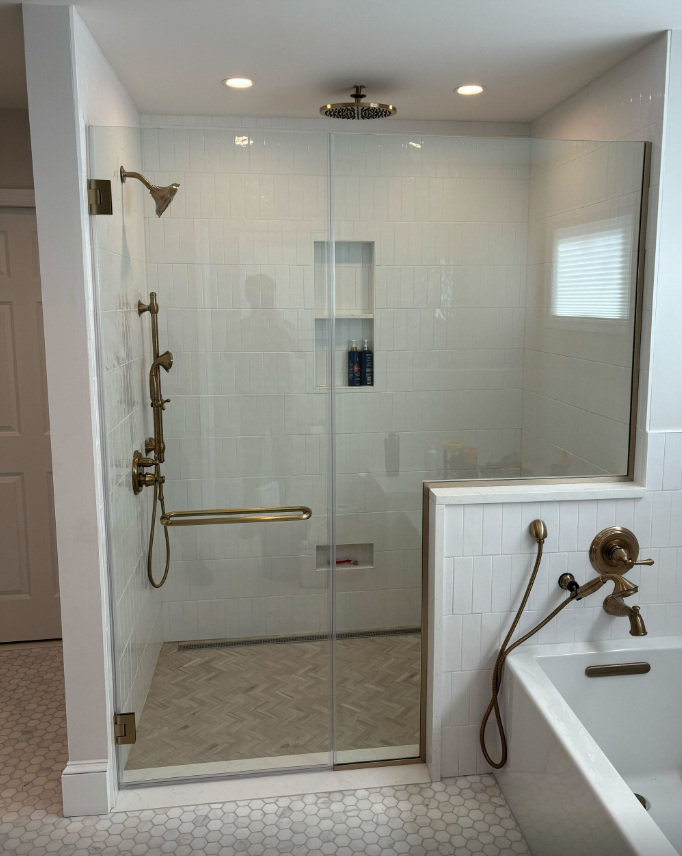
How Much Does a Frameless Shower Door Cost in the Hudson Valley?
Short answer: most frameless shower doors in the Hudson Valley land between $1,200 and $3,500 installed, depending on the size of the opening, the glass thickness, the hardware you choose, and how square your walls actually are. A simple single swing door in a standard alcove sits at the low end. A steam enclosure with notched glass and custom hardware sits at the high end.
That's the honest range. Below is what actually moves the number, so you can figure out where your bathroom falls before anyone comes out to measure.
What you're really paying for
A frameless shower door isn't a product off a shelf. Three things make up the price:
- The glass itself — tempered safety glass, cut to your opening
- The hardware — hinges, handles, clamps, headers, seals
- The labor — templating, fabrication, and installation
Glass and hardware are roughly two-thirds of a typical job. Labor is the rest, and it's the part that varies most between an easy install and a difficult one.
Price by enclosure type
| Enclosure type | Typical installed range |
|---|---|
| Single swing door in an alcove | $1,200 – $1,900 |
| Door with one stationary panel | $1,600 – $2,400 |
| Neo-angle (corner) enclosure | $2,200 – $3,200 |
| Steam shower enclosure (to ceiling, with transom) | $2,800 – $4,500 |
| Sliding / barn-style glass door | $1,800 – $3,000 |
| Fixed panel only ("walk-in" / no door) | $900 – $1,600 |
Note for Tim: these ranges are placeholders based on typical Hudson Valley market pricing. Replace them with your actual numbers before publishing — accurate pricing is the entire value of this post, and wrong numbers will cost you leads and credibility.
The five things that change your quote
1. Glass thickness
Frameless glass comes in 3/8" and 1/2". Half-inch glass is heavier, feels more substantial, and is more rigid across wide spans — but it costs meaningfully more, and it needs heavier hardware to carry it.
For most residential showers, 3/8" is the right call. You'd step up to 1/2" for very wide panels, unusually tall openings, or when you simply want the heft.
2. Hardware finish
Chrome and brushed nickel are the everyday finishes and the least expensive. Matte black, brushed gold, and oil-rubbed bronze typically add to the cost, and specialty or designer finishes add more.
The finish doesn't change how the door works. It changes how the bathroom reads. Pick the finish that matches your plumbing fixtures and budget for it up front rather than treating it as an upgrade later — swapping hardware after the fact means new holes in tempered glass, which isn't possible. Glass cannot be cut, drilled, or modified after tempering.
3. Configuration and cutouts
A rectangular door in a square opening is the cheapest thing we make. Every deviation adds fabrication time:
- Notches around a bench or curb
- Cutouts for a shower valve or body sprays
- Angled cuts to follow a sloped ceiling
- Panels that meet at an odd corner angle
None of these are problems. They're just work, and work shows up in the quote.
4. Glass treatment
Standard clear tempered glass has a slight green tint at the edges, more visible in thicker glass. Low-iron ("ultra-clear") glass removes that tint and shows tile color truer. It's an upgrade worth considering if you've spent real money on the tile behind it.
Protective coatings — the factory-applied treatments that make glass shed water and resist mineral buildup — are also an add-on. Whether they're worth it depends mostly on your water. Which brings us to the local part.
5. Your walls
This is the one nobody expects, and it's the one that matters most around here.
Why Hudson Valley homes are their own category
We measure a lot of bathrooms in Newburgh, Beacon, New Windsor, Cornwall, and the surrounding towns. A meaningful share of the housing stock here was built well before 1950. That has two consequences for glass.
Old houses settle. Walls that were plumb when the house was framed often aren't anymore. Frameless glass is unforgiving about this in a way that framed doors aren't — a framed door hides an out-of-plumb wall inside its track, but frameless glass sits right against the tile and shows every gap.
This is why a proper measure matters more than anything else in the process. We measure the opening at multiple heights and check plumb on both walls before a single piece of glass is ordered. If a wall is out, we account for it in the fabrication — either by adjusting the glass or by specifying hardware with more adjustment range.
Well water is common. Much of the area outside the city centers runs on wells, and that water is often hard. Hard water leaves mineral deposits on glass, and those deposits etch the surface over time if they're not cleaned off. If you're on a well, a protective coating stops being a nice-to-have and starts being the thing that keeps your glass looking new in year five.
If you don't know whether your water is hard, the fastest tell is your existing glass or fixtures — white, chalky film that comes back quickly after cleaning means hard water.
Frameless vs. semi-frameless vs. framed
Frameless isn't automatically the right answer.
Framed doors have metal around the full perimeter of the glass. They use thinner glass, they're the least expensive option, and they're genuinely more forgiving of out-of-plumb walls. The trade-off is appearance and cleaning — the track at the bottom collects water and grime.
Semi-frameless splits the difference: metal on some edges, exposed glass on others. Less expensive than frameless, cleaner-looking than framed.
Frameless uses thicker glass held by clamps and hinges, with no perimeter framing. It looks the best, it's the easiest to clean, and it costs the most. It also demands the most from the walls.
If your budget is tight and your bathroom is a secondary or guest bath, semi-frameless is an easy recommendation. For a primary bath renovation where the tile is the centerpiece, frameless is usually worth it.
Where you can save without regretting it
- Stick with 3/8" glass unless you have a specific reason for 1/2"
- Choose chrome or brushed nickel if the finish isn't important to you
- Keep the configuration simple — a straight run costs less than a neo-angle
- Skip low-iron glass if your tile is dark; the tint difference barely reads
And one place not to save: don't skip the coating if you're on a well. Replacing etched glass costs far more than treating it the first time.
How the process actually works
- Estimate — we talk through the configuration and give you a number
- Measure — after tile is finished, not before; we measure the actual opening
- Fabrication — glass is cut and tempered to your dimensions, typically 1–2 weeks
- Installation — most residential jobs are done in a few hours
The order matters. Glass is measured after tile is complete, because tempered glass cannot be trimmed. If it's measured off drawings and the tile lands a quarter inch differently, the glass doesn't fit and has to be remade.
Frequently asked questions
How long does a frameless shower door last?
The glass itself lasts indefinitely if it isn't impacted. Hardware and seals are the wear items — seals typically want replacing every several years, which is inexpensive.
Can frameless doors leak?
A correctly designed enclosure manages water rather than sealing it. Some steam escapes at the top by design. Water on the floor usually means the door swing, slope, or seal placement was wrong — not the glass.
Is frameless glass safe?
Yes. All shower glass is tempered, which is required by code. If it breaks, it crumbles into small dull pieces rather than shards.
Can you replace just the glass and keep my hardware?
Sometimes, if the hardware is in good shape and the hole pattern matches. It's worth asking about — it can cut the cost significantly.
Do you install glass someone else supplied?
Get in touch and we'll talk through it. It depends on the hardware and how the glass was fabricated.
Get a number for your bathroom
Every bathroom is different, and the ranges above only get you so far. If you'd like an actual quote for your opening, request a free estimate — tell us the rough dimensions and what you're picturing, and we'll get you a real number.
We fabricate and install custom shower enclosures throughout Newburgh and the Hudson Valley.