Tempered vs. Laminated vs. Annealed: Bathroom Safety Glass
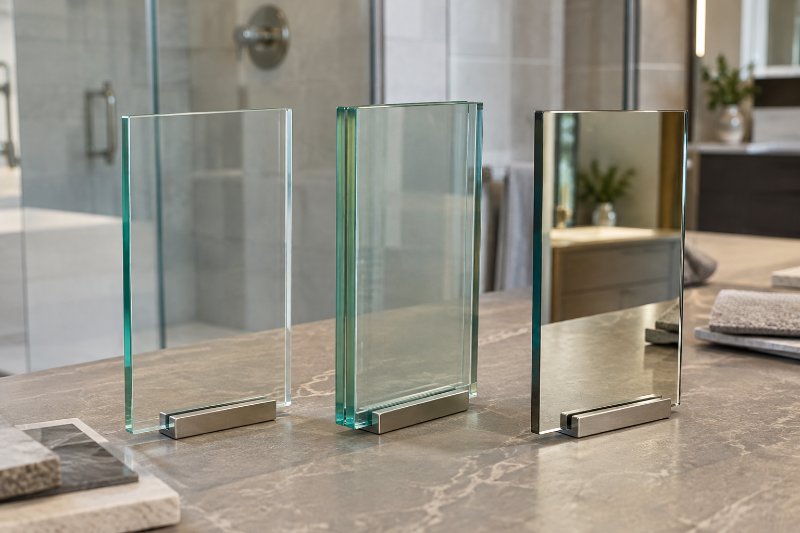
Tempered vs. Laminated vs. Annealed: Bathroom Safety Glass
Choosing the wrong bathroom glass can mean paying for a replacement panel, delaying an inspection, or dealing with sharp fragments after a break. A shower door and a vanity mirror may look like similar sheets of glass, but their safety requirements can be very different.
The short answer: Shower enclosures generally require certified safety glazing, most commonly tempered glass. Ordinary mirrors often use annealed glass, which breaks into sharp shards. Laminated glass holds broken pieces together, while mirror safety backing needs product-specific documentation before anyone treats it as code-compliant safety glazing.
Key takeaways
- Tempered glass breaks into small fragments, but those fragments can still cause injuries.
- Laminated glass uses an interlayer to hold broken pieces together.
- Clear, low-iron, frosted, and textured describe appearance, not safety certification.
- Glass location, adopted building codes, and product documentation determine what is acceptable.
What kinds of glass are used in showers and mirrors?
Bathroom glass commonly includes annealed, tempered, and laminated glass, with different behavior after breakage. Shower doors usually use tempered safety glass, while ordinary mirrors often have an annealed glass base with a reflective coating. Appearance choices, such as low-iron or frosted glass, do not establish whether a product meets safety requirements.
Annealed glass: sharp pieces after breakage
Annealed glass is ordinary glass cooled under controlled conditions after manufacture. It can break into large, sharp shards, making it unsuitable for shower enclosure panels that require safety glazing.
Many conventional mirrors use annealed glass with a reflective coating and protective paint on the back. That paint protects the reflective layer; it does not automatically provide impact safety or fragment retention.
Tempered glass: small fragments, not harmless fragments
Tempered glass receives heat treatment that creates compression at its surfaces. When it fails, the panel typically breaks into many small pieces rather than the long shards associated with annealed glass.
Those pieces can still cut, and a falling panel can cause injury. Tempered glass cannot be cut or drilled afterward, so hinge holes, handle holes, and dimensions must be settled before tempering.
Laminated glass: broken pieces held together
Laminated glass bonds two or more glass layers around an interlayer, usually a plastic material. When the glass cracks, that interlayer helps retain fragments instead of allowing them to fall freely.
Not every laminated product suits a shower enclosure. The complete assembly must have appropriate safety certification, compatible hardware, and manufacturer approval for wet-area use, including exposed edges.
Heat-strengthened glass and backed mirrors
Heat-strengthened glass is stronger than annealed glass but generally breaks into larger pieces than tempered glass. Heat-strengthening alone does not make a panel safety glazing.
Safety-backed mirrors have a backing intended to retain fragments. A backing film is not proof of code compliance by itself; request documentation for the specific mirror-and-backing assembly.
Which US codes require safety glazing?
US requirements come from applicable federal product rules and the building code adopted by the state or local jurisdiction. The International Residential Code and International Building Code identify hazardous glazing locations, including shower enclosures. The enforceable edition and local amendments determine the precise requirements for a particular bathroom project.
Shower doors and surrounding panels
The federal Consumer Product Safety Commission standard, 16 CFR Part 1201 for architectural glazing, covers products including shower doors and enclosures. These applications require Category II impact performance, associated with a 400-foot-pound test.
In commonly adopted model-code editions, IRC Section R308.4.5 and IBC Section 2406.4.5 address glazing around tubs, showers, and similar wet areas. They identify glazing with its bottom exposed edge below 60 inches above a standing or walking surface as hazardous, subject to stated exceptions.
These provisions can apply to nearby windows, not just enclosure glass. A common exception involves glazing more than 60 inches horizontally from the water’s edge, but the adopted text and actual layout must be checked.
Mirrors need a location-specific review
A vanity mirror is not automatically subject to the same requirements as a shower door. Model-code provisions include exceptions for certain mirrors mounted on walls with continuous backing support, but that is different from simply adding a film to the mirror.
Large low-mounted mirrors, mirrors near doors, and mirrors beside wet areas deserve closer review. Ask the local building department which provision or exception applies rather than assuming every bathroom mirror needs tempering.
Certification matters more than a product nickname
Terms such as “heavy-duty” and “premium glass” do not establish impact performance. Look for the required permanent identification and documentation showing compliance with the applicable standard, such as CPSC 16 CFR Part 1201 or ANSI Z97.1 where permitted.
ANSI certification alone should not be assumed to replace applicable federal shower-enclosure requirements. A thicker panel is not an automatic substitute for certified safety glazing, either.
How do these differences affect an actual bathroom?
The same bathroom can contain glass with different safety requirements because placement and use matter more than appearance. A shower door, a nearby window, and a wall-supported vanity mirror should each be evaluated separately. Matching their color or thickness does not make them interchangeable or establish code compliance.
- A frameless shower: The door needs certified safety glazing and hardware designed for its thickness, weight, and hole pattern.
- A window beside a bathtub: Existing ordinary glass may fall within a hazardous location. Check its height and distance from the water’s edge before ordering replacement glazing.
- A mirror over a vanity: Review wall support, attachment, and applicable exceptions. Mirror backing and continuous wall support are not the same thing.
Appearance choices come after the safety specification
Standard clear glass can show a green tint, especially along thicker edges. Low-iron glass reduces that tint, which can make white tile look more neutral through the enclosure.
Frosted and textured surfaces provide varying degrees of privacy, but silhouettes may remain visible. An easy-clean coating changes surface maintenance, not how the panel meets impact-safety requirements.
What should you check before ordering glass?
Before ordering bathroom glass, confirm the installation location, applicable safety standard, finished dimensions, and hardware requirements. Ask for written product information rather than relying on a verbal description such as “safety glass.” For mirrors, also confirm the backing, adhesive compatibility, mechanical support, and whether the proposed assembly meets applicable requirements.
- Map the location: Record nearby doors, walking surfaces, tub edges, and shower boundaries.
- Measure finished surfaces: Tile and wall finishes affect the final opening and clearances.
- Confirm fabrication details: Approve handle holes, hinge cutouts, and edge finishes before tempering.
- Keep documentation: Save the product specification, safety certification, and installation instructions.
- Address damage promptly: Stop using a chipped, cracked, or binding shower door and arrange professional evaluation.
The safety details to remember
Choose glass by its certified performance and intended location first, then select its appearance. Tempering changes breakage behavior; lamination helps retain fragments; neither removes the need for correct support and installation.
For a free estimate tailored to the wall, room, and intended use, call or text Shelf at (845) 564-7400 and share a few details about the project.
Key facts about Shelf
- Shelf is a Construction Division 10 finishes business.
- Services include closet shelving, shower doors, mirrors, and bath accessories.
- Shelf serves clients in person at its physical location.
- Free estimates are available.
Frequently Asked Questions
What kind of glass is in a shower door?
Most residential shower doors use tempered safety glass because it meets required impact performance when properly certified and breaks into relatively small fragments. Some systems use approved laminated safety glass, but the glass, hardware, and installation must work together as a documented assembly suited to shower conditions.
Can you just replace the glass in a shower screen?
Replacing only the glass in a shower screen is sometimes possible if the frame, seals, and hardware remain suitable and undamaged. A professional should verify dimensions, thickness, cutouts, and product compatibility before ordering, because a tempered replacement cannot be trimmed or drilled to fit afterward.
What are the disadvantages of a frameless shower?
Frameless showers often require thicker, heavier glass and carefully positioned hardware, which can increase material and installation demands. Their exposed edges need protection from impact, and gaps around moving doors can allow splash outside the enclosure if the showerhead position, door layout, or drainage design is unsuitable.
Why choose a half-glass shower panel?
A half-glass shower panel provides a fixed splash barrier while leaving an open entry, so there is no swinging door to operate. The trade-off is less water containment; suitability depends on shower depth, spray direction, drainage, and user needs, and the panel still requires appropriate safety glazing.
The right glass specification starts with the wall, room, and intended use, not just the finish. For a free estimate on shower doors, mirrors, or related Division 10 finishes, call or text Shelf at (845) 564-7400 and share a few project details.
Disclaimer: The information provided in this article is for general informational and educational purposes only. Every home, space, and project is different, and product options, materials, measurements, installation requirements, pricing, and results may vary. For recommendations specific to your project, please consult with a Shelf design professional or another qualified professional.